

xplain Turbo Quant to me
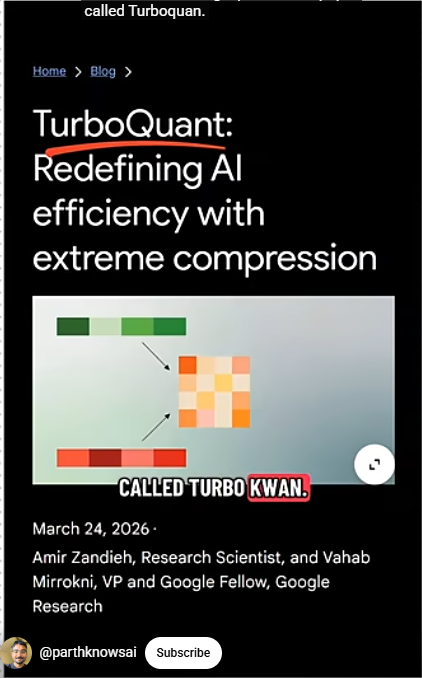
TurboQuantis a compression technology developed by Google Research designed to drastically reduce the memory required by large language models (LLMs) and vector search engines. It specifically targets the Key-Value (KV) cache, which acts as a “short-term memory” for AI models, storing previous parts of a conversation so the model doesn’t have to re-calculate them for every new word. [1, 2, 3, 4]
Key Benefits
- Memory Reduction: It shrinks the memory footprint of the KV cache by at least six times without measurable loss in accuracy.
- Speed Boost: By reducing data bottlenecks, it can speed up the “attention” calculations in models like Gemini by up to 8 times on high-end hardware like the NVIDIA H100.
- Longer Context: This efficiency allows AI to handle much longer documents or conversations (up to 8x more context) on the same hardware.
- Training-Free: It can be applied to existing open-source models like Mistralor Gemmaimmediately without needing to retrain or fine-tune them. [1, 2, 3, 4, 5]
How It Works
TurboQuant uses a two-stage mathematical process to “pack” data more efficiently than traditional methods: [1, 2]
- PolarQuant (The Packing): Instead of storing data points as standard coordinates (like “3 blocks East, 4 blocks North”), it converts them into a polar representation (like “5 blocks at a 37-degree angle”). This allows the data to be compressed into just ~3 bits per value without the “memory tax” of extra scaling metadata.
- QJL (The Correction): Compression usually creates tiny errors. TurboQuant uses a technique called Quantized Johnson-Lindenstrauss (QJL) to add a single “sign bit” (+1 or -1) as a correction layer, restoring the data’s original accuracy almost perfectly. [1, 2, 3, 4, 5]
Why It Matters
Before this breakthrough, users often had to choose between a “smart” model that forgets things quickly (small context) or a model with a “long memory” that was incredibly slow and expensive to run. TurboQuant removes this bottleneck, making advanced AI cheaper to run in the cloud and more capable on local consumer devices like a standard desktop. [1, 2, 3]